Jul 3, 2012

The Other Italy


Having seen Rome, Florence and Venice, I ventured into the other Italy with Milan, Rimini as the main two destinations, and Riccione, San Marino, Portofino, and Como as day trips.
Let’s begin with a few Milanese snapshots:

The Duomo and its Piazza is probably the liveliest place in Milan, beautifully spacious though filled with tourists. The view of the Cathedral looming on the piazza makes it a dreamy place to visit whether to take your morning sip of coffee or to sit idly at night and enjoy the lights of the cathedral and the duomo.


A little off the piazza, you can go to the 7th floor of one of Milan’s main shopping malls, the Rinascente, and choose between the indoor deli (De Santis) for its most delicious sandwiches of cheese and meats and its fresh Anastasia salad, or step outside to have dinner with a view of the Cathedral and a choice of four restaurants, my favorite being Maio for its juiciest burger and its colorful and fruitful iced tea.

To go around Milan, you can go online (www.bikemi.com) and purchase your username and password to get a bike from the many points across the city. A ride towards and around Parco Sempione to the north-west of the Centre is very pleasant and you can pass the Castello Sforzesco and Arco della Pace.

An hour drive north of Milan can take you to Lake Como and its surrounding towns. Festivals around the lake are year-round but the lake itself offers a beautiful view.

I happened to be there when they were having a Swing Dance Festival and watching the dancers was a pleasure.

To the South of Milan, you can take a train to Santa Margherita and head south-west along the coast to Portofino or other coastal areas by bus, or more conveniently, you can drive the 2+ hours from Milan south towards Portofino for views not to be missed.
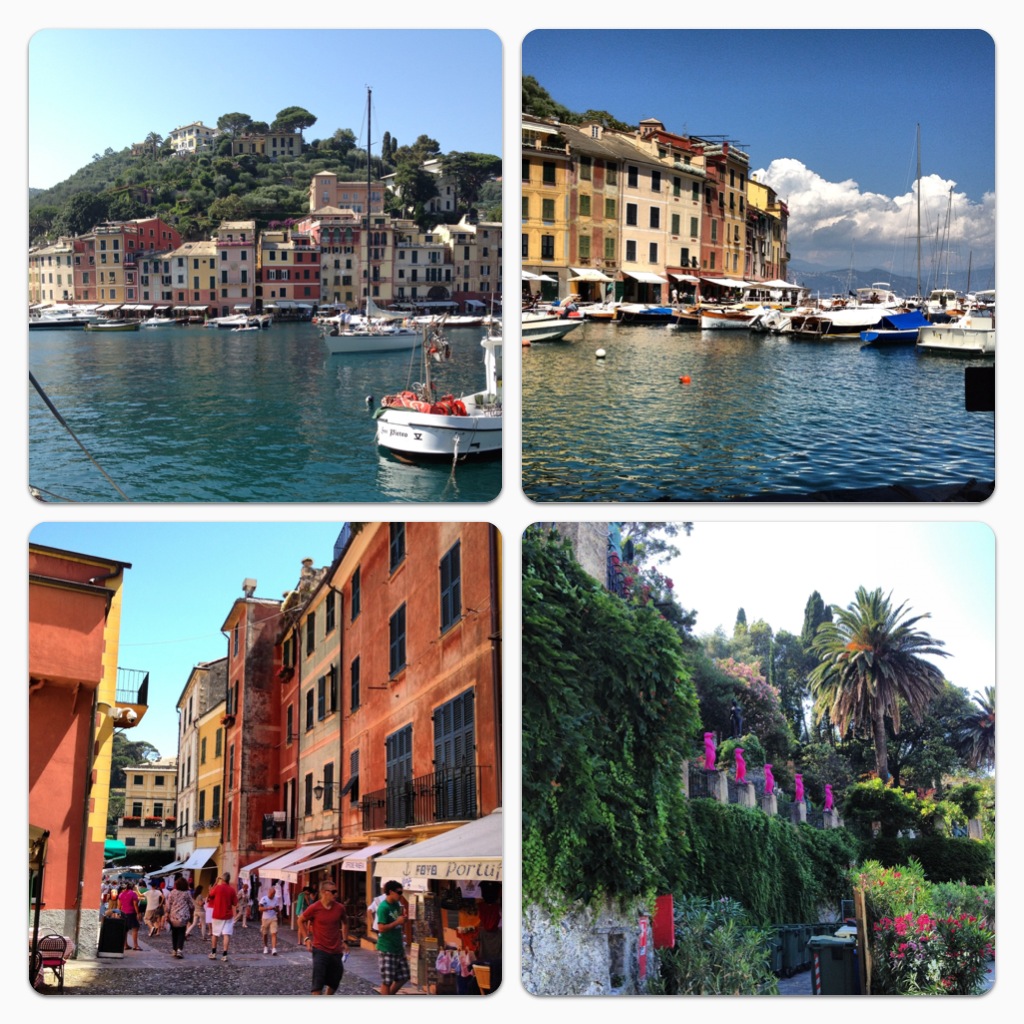
And when it’s time for lunch, don’t miss the grilled sea bass in Ristorante Delfino right on the marina. The Scampi is just as good, almost.

For a place to swim near Portofino, the best is Bagni Fiori in Paraggi, between Portofino and Santa Margherita. For around 60 euro, you can get two beach chairs, umbrella, and two towels.

Another option closer to Santa Margherita would be the beach associated with Hotel Helios with its partially enclosed sea-water pool aside from its access to the sea itself (a 50 euro value).

But for a real sandy beach experience, you would want to take the 4+ hour drive to Rimini on the east coast, stopping by Verona to take a peek at Juliet’s alleged window but also to walk around the city.

Once in Rimini, these sandy beaches and clear waters will force you to spend all day in your swimsuits either for a lazy day of relaxing with a book, or if you want activities, there are dances, volleyball fields, boats, surfboards and other sea-related options.

At night, you can drive or take the bus to Riccione for a more lively night scene. Dinner of delicious Pasta and Pizza at Pizza Maria Dina or Canasta on Viale Maria Ceccarini is highly recommended.

And if you want some history, you can drive west to the Republic of San Marino, one of the few independent states within a state (Vatican and Monaco being the other two). The Castle at the top is a good destination for the view it allows you of the city, and for that walk into the past often associated with castles.

This is barely a glimpse into my trip, which was itself a mere glimpse into the beautiful Italy. The pictures can't do it justice. You have to smell the air, taste the food, and hear the sounds around you to really appreciate the beauty. Looking at the pictures now, I miss the actual sights. A picture might be worth a thousand words, but an actual sensual experience is priceless.

*My tribute to Italy is prompted by Spain's victory in Euro2012. Spain can win a thousand champions, Italy remains the most beautiful country.

Apr 17, 2012

My trip, again, to Manhattan

This is a select expose of Manhattan as I already posted plenty on it in 2008 here.

Because there’s always a new thing to see in Manhattan, and because books are my favorite people (?), I begin this post with this picture of Scribner looming larger than St Patrick’s Cathedral behind it. Literature always comes first for me.


And because art comes hand in hand with literature, I select for you two works of art from the Metropolitan Museum. First I give you James Rosenquist’s House of Fire (1981) that piqued my interest with its reds. 


Next, here’s Francois-Josephy Navez’s The Massacre of the Innocents, “Exhibited to great acclaim at the Brussels Salon of 1824, this work presents the Massacre of the Innocent as an intimate family drama, whose ‘frightening realism’ struck critics.”


Massacre and fire would naturally bring to mind the necessity of presenting you with the 9/11 memorial. The park is not completed yet, but personally, the site touched me more when it was left as ruins of the buildings. Somehow rebuilding this, with all the good intentions meant by it, lessened the emotional effect it left on me the two times I visited after 9/11. (2004 and 2008) 


And from destruction turned to memorial, I take you to nature created by New York in the next three examples. The first is a small hanging garden as part of The Irish Hunger Memorial in Battery Park, designed by Brian Tolle, Gail Wittwer-Laird, and 1000 Architect in 2002 to commemorate the Great Irish Famine of 1845-52. 


The second is that huge construction called Central Park, designed by Frederick Law Olmsted and Calvert Vaux as the Greensward plan in 1858, as viewed all the way in the distance behind the concrete jungle of New York. 1,600 residents of the park area, mostly poor African-Americans and Irish, had to be evicted to construct the park.


The smaller park you see by the green Metlife building is Bryant Park behind the public library, better viewed in the following picture. No detailed history for this one, except to say that by the 1970s the place was nicknamed Needle Park (for clear reasons) until the park was cleaned in the 80s.


The third, and my recent discovery this year, or rather a friend’s discovery pointed to me, is The High Line Park, an old raised railway turned into park. Designed by James Corner, Diller Scofidio, Renfro, Piet Oudolf, Buro Happold, the park opened in 2009, and it runs for 1.5 miles (2.4 km) parallel to 10th Avenue from Gansevoort St (by 12th st) to 34th St.


Oops. Where did Yasmina come from? J
An amazing walk would be from Battery Park to the entrance of this park, by the Hudson river, with a view of New Jersey and many small scattered rest areas on the way. That’s 2.8 miles (4.5 km). That would give you a spectacular 4.3 mile walk that will not disappoint you.

Now enough about nature, real or constructed, and let me end with art and literature. As you walk around West Village, you can't help but gawk at the walls of buildings turned into museums of modern art.


And in close vicinity (specifically on 3rd st between Avenue B and C) You come across the Nuyorican Poets Café, which, unfortunately, I was only able to visit once due to the short duration of my trip. 


But that one visit made this, now, my most certain future bite at the Big Apple. It was open mic day and we were dazzled by poets and musicians.

And this ends my short slideshow of my favorite city in the world. (Next post will be on the second part of this trip: Boston)


Mar 12, 2012

A Separation (جدایی نادر از سیمین)


This post is long overdue. It’s about time I report to you on A Separation (جدایی نادر از سیمین), a movie I watched while visiting a friend in Dallas last weekend.

In general, if I report on something, it means it won my approval one way or another. So how did A Separation win my approval? Let me count the ways:

It won my approval for its depth and breadth and height

No. Seriously. Enough of the Brownings. Here’s why I recommend this movie:

The cinematography was interesting. The handheld camera technique might cause the audience some discomfort. It certainly did that to my movie partner. However, though this technique is often used haphazardly by movie makers to assert their familiarity with the revival of this school of cinematography in the same way that stream of consciousness is often used haphazardly by modern novelists, this time the technique matched the content, in a rather Wordsworthian content/context symmetry, just not a very Romantic one*.

The story involves, as the title suggests, the separation of Simin and Nader. But notice the indefinite article A in the English translation. It is not without significance. This is not a definite story. The/A separation here is not simply that of Simin and Nader, but that between right and wrong, and the undesirability and complexity of choosing between them. A complexity that is spoon-fed to the audience in the last scene of the movie (But I won’t spoil that for you). This is not a movie about what happens when Simin and Nader separate. This is a movie about what happens when right and good and true are at conflict. An old dilemma when it comes to literature. Should Cathy have stayed a tormented life with Heathcliff as opposed to her decision to try a better life for both of them? Should Jane have accepted Rochester’s marriage proposal that came only after he lost land and sight? Should Frankenstein have created a female monster/partner? Should Dexter’s sister play cop or sister upon discovering her psychopath brother with blood on his hands?  Should the last scene of The Sopranos end the series with the Sopranos apparently living happily ever after? Why does art insist on burdening us with these philosophical questions? Can’t we just be entertained freely?

But I digress and babble.

So the burdening question here is thus:

Having been abandoned by his wife for his refusal to leave Iran and provide his daughter with what would presumably be a better life elsewhere, Nader had to hire Razieh to care for his Alzheimer-inflicted father. The hired help happens to be pregnant. Nadir’s knowledge of that pregnancy was a question soon answered. In a moment of anger probably or probably not justifies, Nader pushes the pregnant woman out of his house, consciously or not so consciously aware of her pregnancy, possibly causing her to tumble down a few stairs. Razieh later sues Nader for the loss of her unborn child. Nadir’s knowledge of her pregnancy is pivotal to the verdict he will receive from judge. As the events unfold, we learn that he might have known about the pregnancy, but with that comes the knowledge that the miscarriage might have been caused by an earlier incident. Doubt. (Shakk). A term Razieh uses quite frequently to refer to her own doubt and therefore possible guilt at framing a man for a miscarriage he was not directly responsible. But this shakk is what the audience is left with as well, epitomized in the brilliant acting of Termeh, Simin and Nadir’s 11 year old daughter, as she struggles to decide whether her father is guilty or not.

Now enough about the content. Let’s go back to the harmony of form and content. In movies we want a good camera, good plot, and good acting. Having vouched for the first two (Read above in case you missed that), let me move to the brilliant acting. The 11 year old referred to in the last paragraph is one example. But other examples are aplenty. The father playing the part of a man with Alzheimer did such a pretty good job that we are left actually considering whether this is indeed an act. Simin is a brilliant actress. And even the young daughter of the hired help masters her role as we see those inquiring eyes looking through doors in an attempt to decipher what is happening in the adult world she lives in.

Good camera. Good acting. Good plot. Dear audience, the verdict is in. Without a shakk this is a great movie.

*Or if you wish, a more philosophical Hegelian concept of the reciprocal revulsion of form and content.
p.s. Simin (Leila Hatami) is a pretty good looking redhead here.

Feb 17, 2012

Cody Daigle's William and Judith at The Liddy Doenges Theatre


Event: William and Judith by Cody Daigle
Place: The Liddy Doenges Theatre at Tulsa Performing Arts Center
Time: Thurs 16 Feb, 8:00 pm

This is a small stage. Proximity to the actors, as usual with small stages (I remember Anna Christie at the Donmar Warehouse), adds a certain edge to the audience’s reaction to the play. Unlike shows we see on screen, watching a play on stage makes this an experience quite different, even when the material, a fictional story, is basically the same as what we see on stage. And although the screen pulls us further into believing what we see by its ability to manipulate visual effects to the service of the story and the effect a movie’s soundtrack has on our emotional involvement, a minimalist stage somehow pulls its audience with its own magical thrill, often sucking us even deeper into the story it portrays for us simply by isolating all external factors, visual and auditory, and forcing us to focus on the act and the words.
But enough of that, now the play.
Open curtain (there is no real curtain of course. This is, after all, a modern play where curtains become more and more obsolete, and an enactment of a Shakespearean time, when curtains did not exist.)
But for the sake of the thrill, let’s go with Open Curtain.
William has been suffering from a writer’s block and has been assisted in his last 2 or three plays by no other than his successor John Fletcher (that Jacobean playwright who barely ever made any appearance in Intro to Lit classes, was brushed over in drama classes, and briefly and insignificantly touched upon in any Shakespearean drama class. Poor John overshadowed by the bard that preceded him). William’s sister, Judith, refusing to marry the man her father has chosen for her, disowned by her family, turns to her older brother in memories of times they used to share as children, writing plays under a tree. This appearance is expected and anticipated by an audience who knows that this play is based on Virginia Woolf’s “Shakespeare’s Sister” from her A Room of One's Own where she imagines the sad fate of a woman of genius in Shakespeare’s time. (feminists just love these stories of what ifs?) What baffled and won the audience’s claps and laughs and obvious acceptance is the dialogue used in this play. This is a very well written play that means to amuse as it brings life to Woolf’s imaginary story. The acting was superb: Judith is the strong outspoken English woman, even when she finally gives William permission to steal her Tempest. William’s seemingly selfish and obnoxious playwright personality puts him at center stage as he gradually shows us his reluctance to teach his daughter what he taught his sister for fear of a similar fate. And Fletcher the poor playwright hidden in the shadows of Will plays his part exceptionally well.
Now I’m more thrilled to go see how Daigle presents The Tempest on stage. He already got my approval for this one.

Cody Daigle, I salute you and thank you for a beautiful night.

Jan 22, 2012

Octavia Butler: Kindred


I just finished reading Octavia Butler’s Kindred. I picked it up because I wanted to expand my sci-fi readership. And somehow a novel that is part sci-fi part slave narrative seems to feed right into my interests. It’s like reading a book co-authored by Toni Morrison and Aldous Huxley, or Alice Walker and Ursula Le Guin, or Alex Haley and Frank Herbert. Okay. You get the picture.
Now let’s talk about the novel.

Dana, living in California in 1976, is repeatedly transported to 19th Century Maryland. Gradually she learns that she is transported by some unexplainable powers of her white ancestor Rufus Weylin who calls her into his plantation whenever his life is at risk. This starts when Rufus is a child and continues till he dies. Rufus is a plantation owner and Dana soon realizes that her journeys into the past are needed to insure her own existence, as Rufus will father Hagar from his slave Alice, and Hagar is Dana’s great grandmother. And though she begins by questioning her role in his survival, she is soon to shake that doubt and accepts this tole.
Again, what would have happened if the boy had drowned? Would he have drowned without me? Or would his mother have saved him somehow? Would his father have arrived in time to save him? It must be that one of them would have saved him somehow. His life could not depend on the actions of his unconceived descendant. No matter what I did, he would have to survive to father Hagar, or I could not exist. That made sense.
But somehow, it didn't make enough sense to give me any comfort. It didn't make enough sense for  me to test it by ignoring him if I found him in trouble again. 
Preparing to read sci-fi, this novel’s theme of slavery seems to have overshadowed the sci-fi element, at least for me. Though the actual transportation, its details and the way the characters deal with it makes this an interesting new look into sci-fi, it is Dana’s life on the plantation that is most captivating here. How would a modern day black woman deal with being a slave? This seems to be the question this novel poses. How submissive will modern day Dana be when she is hardened (or softened) by actually being a slave? And how would Kevin, her white husband, behave when, in one of her journeys, he is also transported with her? 
But Dana herself knows she is a mere observer and isn't really living the life of a slave as she begins to realize how both Kevin and herself are fitting rather too well in their life: 
We weren't really in. We were observers watching a show. We were watching history happen around us. And we were actors. While we waited to go home, we humored the people around us by pretending to be like them. But we were poor actors. We never really got into our roles. We never forgot that we were acting.
Yet, her observer state does not prevent her from feeling guilty at being the woman who saves Rufus's life. Butler highlights Dana’s feelings of guilt over any other feelings of being transported across time and place. Dana visits the plantation 6 times, saving the slave-owner Rufus from imminent death in every one of her visits. This makes her, in the eyes of other slaves on the plantation, a culprit in their enslavement. And like other submissive and complacent slaves, Dana chose her own safety, a choice she has earlier looked down upon when she notices it in another slave woman, Sarah:
She had done the safe thing - had accepted a life of slavery because she was afraid. She was the kind of woman who might have been called "mammy" in some other household. She was the kind of woman who would be held in contempt during the militant nineteen sixties. The house-nigger, the handkerchief-head, the female Uncle Tom - the frightened powerless woman who had already lost all she could stand to lose, and who knew as little about the freedom of the North as she knew about the hereafter.
And she soon admits that she genuinely cares for Rufus, even as he enslaves her, has her whipped, and almost causes her death in one instant. Guilt over rescuing a man who is constantly cruel to his slaves haunts Dana more than any other feelings she might have by leaving her time/place. However, it is finally as threat to Dana’s body that she manages to end this cycle. As long as Rufus’s interest in her is as his savior, Dana accept becoming his slave, but when he becomes interested in her body, upon the death of his Alice, she immediately decides to end this cycle and kills him. I’m not sure what to make of this. Slavery is not longer the element that repels Dana from Rufus. She seems to have accepted that, even justifies it. But in the end this is a novel about a woman whose body refuses to be violated, not about a black woman who refuses to be enslaved. And even though she utters her rejection to being his slave, she has long been accepting the duties of a slave, it is the duties of a lover, forced by a slave-owner, that she actually resists with her knife.
A slave was a slave. Anything could be done to her. And Rufus was Rufus - erratic, alternately generous and vicious. I could accept him as my ancestor, my younger brother, my friend, but not as my mater, and not as my lover. He had understood that once.
I twisted sharply, broke away from him. He caught me, trying not to hurt me. I was aware of him trying not to hurt me even as I raised the knife, even as I sank it into his side. 
Of course the body does matter here. In the end, when Dana is finally free (through Rufus’s death) she is left with her arm amputated. Her body is violated, if not sexually, then indeed physically. Her arm remains in the grips of Rufus's hand even when she manages to come back to her 1976 life. Butler argues that she does this because she refuses to leave Dana untouched by her experience, that it doesn’t make sense to her that Dana should go back to her old life untouched. But Dana is left untouched. Her life continues as it had been before. Her awareness of slavery hasn’t changed. She knew what it was as did Kevin. It might now be a more personal awareness, but it’s not a big change. And having been responsible, through saving Rufus, for so many of her slave friends being killed, whipped, and sold is too huge to be equated with a loss of an arm.

Now don’t let these questions and investigations fool you. This is a very good novel, and I don’t think Octavia Butler needs me to vouch for her. This novel is an interesting investigation of the slave mentality. It is also an interesting twist to the usually sci-fi novels. It is worth reading, interesting to read, and most enjoyable as well. As sci-fi, I wouldn’t rate it as a favorite. As slave-narrative, I also wouldn’t rate it as a favorite. But as one that combines two unlikeable themes, it stands out indeed.

Dec 22, 2011

Chocolate-Chip Pecan Pie


Pie:
1/2 cup butter
1 1/3 cups flour
1/2 tsp salt
3-4 tbsp cold water

Filling:
1 cup semisweet chocolate chips
1 cup light corn syrup (or boil 1 cup sugar with 1/3 cup water and stir on low heat till it thickens)
1 cup firmly packed light-brown sugar
3 large eggs
2 Tbsp stick butter, melted
1 1⁄2 tsp vanilla extract
1⁄2 tsp salt
1⁄2 cup chopped pecans
11⁄2 cups pecan halves

Method:
Heat oven to 350°F and place oven rack in lowest third of oven
Mix pie ingredients, adding 1 tbsp water at a time.
Shape into a ball then roll on floured surface into a 12" circle.
Fit pie shell in 9" pie dish and crimp edges.
Scatter chocolate chips evenly in crust. 
Whisk syrup, sugar, eggs, butter, vanilla, salt and chopped pecans in a large bowl until well blended.
Pour evenly over chocolate chips. 
Arrange pecan halves on top.
Bake 50 minutes, or until crust and pecans are browned. 
If crust begins to darken too quickly, cover edges with foil.
Cool completely on a wire rack.

Dec 16, 2011

Sade in Abu Dhabi

Last night I went with a few members of my family to the Sade Concert at Yas Arena in Abu Dhabi. I leave you here with a few pictures and comments. Needless to say, Sade's performance was dazzling and the audience was mesmerized throughout.
After warming the audience up with Bob Marley's Don't Worry, Be Happy, Sade steps on the stage as the music begins playing Soldier of Love, quite a hit in her album of the same title, the audience naturally screams in excitement. Sade comes on stage dressed for the part:
 Following that song, Sade gives a brief hello to the audience before going back to an old hit in her Diamond Life Album with her Your Love is King. She goes back to her latest Album in Skin then skips back again to one of my own favorite albums of her, Love Deluxe, singing Kiss of love with a very picturesque Background:
 And when the music starts playing its ba-boom-boom tune, the audience rises in applause knowing what's to come. And Sade does not disappoint. She forces the whole stage and audience to go ba-boom ba-boom with her latest hit, Love Is Found, accompanied by a silhouetted background of her dancing with her fabulous male partner. The image here fails to capture what we were actually witness to. The heart goes ba-boom ba-boom just looking at this man move.
 She follows this with In Another Time (Solder of Love Album) before taking a short break. The break is followed by a short movie clip prepping us up for a song that again took the audience back to what started Sade. Smooth Operator apparently remains an all-time favorite with Sade and her audience and the set intensified this feeling:
 Then Sade sits on the edge of the stage and sings Jezebel (Promise) in a black and white setting that plays quite a role here:
 After Bring me Home (Soldier of Love) album and Is It a Crime (Promise), the stage shows us a banner that reads: Sade Live Tonight in Abu Dhabi while Sade sings The Safest Place, again from her new album.
 This is followed by All About Our Love (Lovers Rock) and Paradise (Stronger than Pride) before Sade retires again to change while the band sings Nothing Can Come Between Us (Stronger than Pride) with the Audience.
When Sade finally returns, she does so behind a white curtain that teases the audience who now sees that Sade comes in a new look, singing Morning Bird (Soldier of Love) followed by a song long waited for by me personally and, I have no doubt, by every member in the audience, King of Sorrow (Lovers Rock). In this white elegant dress and with her hair let down, Sade captivates her audience and steals their hearts away.
 Then we listen The Sweetest Taboo (Promise), The Moon and the Sky (Soldier of Love), Pearls (Love Deluxe), No Ordinary Love (Love Deluxe) and finally By Your Side (Lovers Rock) as Sade once again reminds us that it is impossible to be able to count her many hits, and that, indeed, all that she gave us are hits.

After Sade says her goodbyes and acknowledgments to the band, and after the expected time has lapsed for the audience to cheer and call her back, Sade dazzles us back on stage in red as she is taken on a podium that lifts her as high as the skylines in the screen behind her while she sings Cherish the Day (Love Deluxe)

The concert ends and we leave reluctantly. As we leave we see the faces of people leaving the stage. We chat with a few who are as baffled as we are by Sade's magnificent performance. As we leave Abu Dhabi today, we meet a few more members of the audience in the airplane and finally airport in Kuwait and the topic remains ever so lovingly: Sade gave us a night that we will never forget.